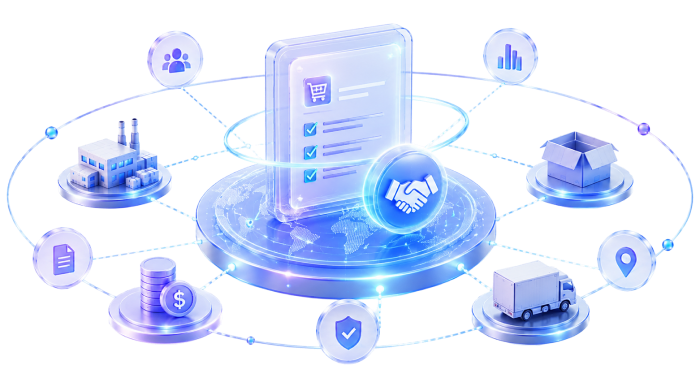
See the Whole Manufacturing Record, From Every Partner in Your Manufacturing Network.
Materials and consumption, equipment and reservations, in-process and release testing, cycle time and yield — the full manufacturing record for every batch, at the depth a real question needs. It arrives from partner MES, LIMS, QMS and ERP without anyone chasing it or re-keying it, and it builds while the batch is still running rather than landing once it is over. Every record sits against the purchase order the batch was made for.
Request a DemoIn This Solution

The Complete Batch Record
Materials, equipment, testing, cycle time and yield together.

Live Batch Status
Configurable states with counts, planned to released.

Planning Milestone Tracking
The full date chain, planned against actual.

Data That Arrives On Its Own
Ingested from partner MES, LIMS, QMS and ERP.
Configurable Status Models
Each sponsor network defines its own states.
The Data Exists. It Just Doesn't Reach the People Who Need It.
Every detail of a batch is recorded somewhere — in the partner's MES, LIMS, QMS and ERP. Almost none of it reaches the sponsor. What crosses the boundary is a status slide and a PDF, produced by hand, on request, after the fact.
Why Existing Approaches Fall Short

A Summary, Not the Record
What arrives is a status slide, not the materials, equipment, tests and yield behind it. The moment a real question comes up, the detail has to be requested.

Chased, Not Delivered
Nothing moves on its own. Every update is asked for, assembled by a person, and re-keyed at the other end.

Late By Construction
Batch data lands when the batch is finished, so problems get reviewed after the event instead of intercepted during it.
What It Costs Sponsors, CMOs, and CDMOs

Sponsors
A question about a batch takes days to answer, because the answer sits in a system they cannot reach.

CMOs and CDMOs
The same data is extracted and reformatted for every sponsor request, on top of actually running the plant.

Both Sides
Effort goes into moving data between two organisations instead of into using it.
Every Batch, in Full, Without Asking for It.
Collabrix ingests batch manufacturing data from partner MES, LIMS, QMS and ERP in a standard message format and presents it as one governed record per batch — complete, current, and visible to both sides at the same time.

The full record, not a summary
Materials and consumption, equipment and reservations, in-process and release testing, cycle time and yield — held together against the batch, at the depth an investigation needs.

Delivered, not requested
Data is ingested from partner systems on defined triggers. No portal logins, no email requests, no re-keying at either end.

Current while the batch runs
The record builds during execution rather than at the end, so a question can be answered while the batch is still in the plant.

Sourced and governed
Every field carries the system it came from and the time it was last updated, and role-based access decides what each user sees.
Answers From the Record, Not From a Request.

Answers in minutes, not days
A question about a batch is answered from the record, instead of being routed to the partner and waited on.

Less manual reporting
Partners publish batch data once, instead of extracting and reformatting it for every sponsor who asks.

Problems caught during execution
Because the record is current, issues are intercepted while the batch is running rather than reviewed afterwards.

Release readiness in view
Testing and documentation progress is visible ahead of the release decision, not at it.
How Manufacturing Collaboration Works.
One shared batch record, assembled from partner systems as the work proceeds — from the first feed mapped to a complete, sourced manufacturing history.
Partner systems publish batch data
MES, LIMS, QMS and ERP feeds are mapped once per integration and pre-processed into a standard message format, whatever shape they arrive in.
The batch record assembles itself
Materials, equipment, testing, cycle time and yield land against the batch as the work proceeds, each field carrying the system it came from.
Planning dates are tracked against target
Manufacturing milestones — from raw material release through batch record issuance, manufacture, release testing and inspection — are held with both planned and actual dates.
Status advances through the configured model
Each batch moves through the states that sponsor network defined for itself, and the live counts update with it.
The record stands as the manufacturing history
Complete and sourced, so a batch can be reconstructed from what is held rather than reassembled from what people remember.
Where Manufacturing Collaboration Happens.
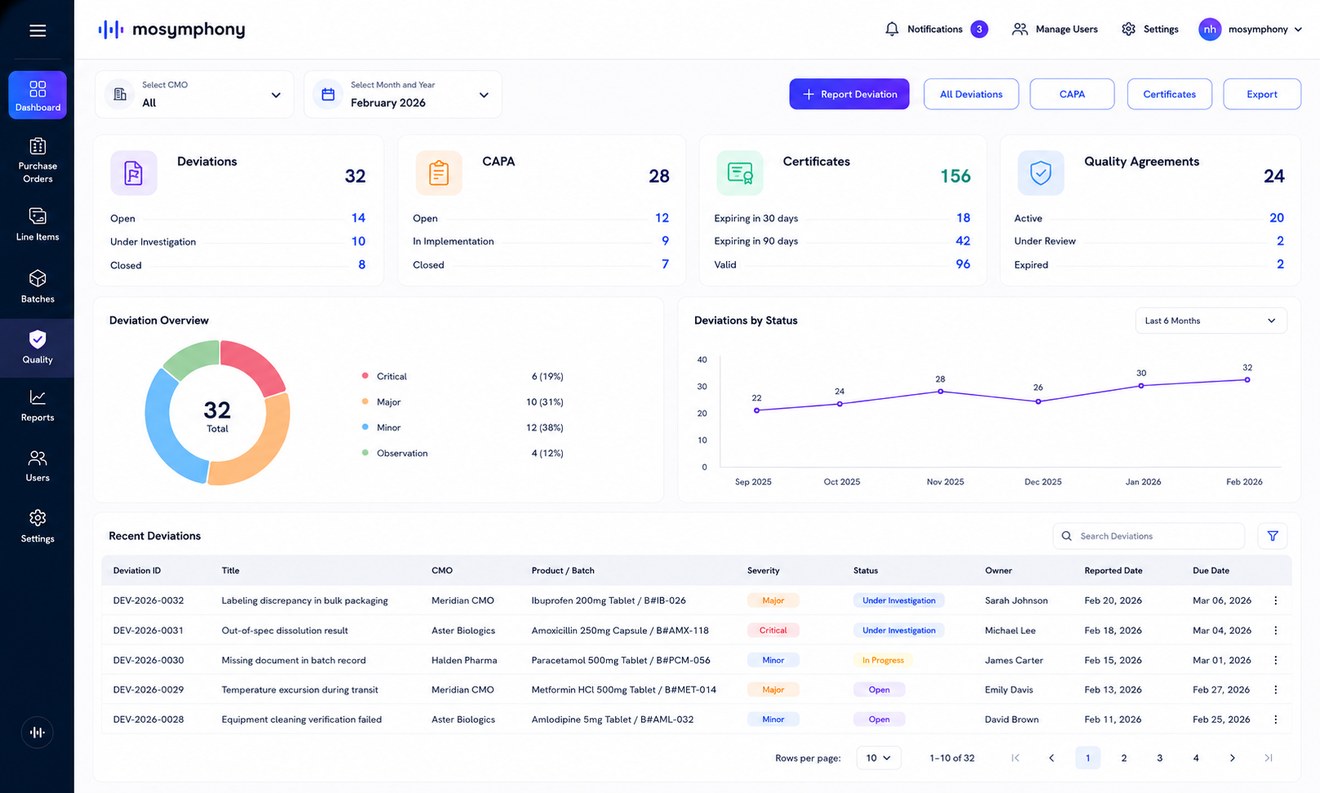
The Manufacturing Collaboration dashboard is where the assembled record is read — counts by batch state across the network, and a detail view per batch covering planning, materials and consumption, in-process and release testing, equipment, cycle time and yield.
Standardized ingestion
Each incoming dataset is pre-processed into a standard message format, whatever system it came from.
Standardized outbound messaging
Outbound data leaves as a standard message, on defined triggers, to the systems that consume it.
Broad system integration
Data is drawn from ERP, MES, QMS and LIMS across the sponsor and partner estate.
Role-based governance
What a user can see, and what they can act on, are both controlled by role.
Related Solutions
Manufacturing Collaboration covers the batch manufacturing record. The neighbouring solutions pick up the order that precedes it, the shipment that follows, and the quality record that runs alongside.
Technology Transfer
Challenge
Technology transfer scattered across files — risks errors and delays.
Outcome
Faster, cleaner transfers with less rework.

Forecast Collaboration
Challenge
Partners plan against outdated or informal demand signals.
Outcome
Accurate capacity planning with fewer supply gaps and less excess.

Procurement Collaboration
Challenge
Procurement and changes handled over email cause misalignment.
Outcome
Partners stay in sync and procurement moves faster.