Two Quality Systems. One Shared Record of the Work.
Deviations, investigations, CAPAs, change controls and out-of-specification results worked in one place by both quality organisations — with the documents behind them read into structured data rather than re-keyed, and each side’s quality system left exactly where it is as the system of record.
Request a DemoIn This Solution

One Workspace per Event
Deviations, CAPAs, change controls and OOS worked together.

Both Sides’ Status, One View
Each organisation’s state held against the same event.

Documents Read, Not Retyped
Certificates, records and reports arrive as structured data.

Queries On the Record
Raised, assigned, answered and closed against the event.
Quality Data Arrives as Documents. Quality Systems Need Fields.
A partner’s quality record is complete and carefully produced — and it arrives as a certificate, a report or a scanned batch record. The receiving organisation needs those same facts as fields in its own system, so the gap between the two is closed by a person reading one and typing the other.
Why Existing Approaches Fall Short

A Document Is Not a Record Entry
The information is complete and unusable at the same time. Nothing can act on it — no workflow, no trend, no alert — until someone has turned it back into data.

The Handoff Creates Its Own Findings
Re-keying is careful work done at volume under time pressure, and a transcription slip becomes a quality finding in its own right — one that has nothing to do with how the product was made.

The Record Lands After the Event
Batch documentation can arrive well after the batch itself, so an event surfaces once the window to influence anything has already closed.
What It Costs Sponsors, CMOs and CDMOs

Sponsors
Qualified quality people spend their hours reading and entering rather than assessing, and review cycles stretch because the work starts late.

CMOs and CDMOs
The same quality pack is reshaped for every sponsor’s format and cadence, and every follow-up question returns to the people who produced it.

Both Sides
Two quality organisations work the same event in two systems, and keep them aligned by email — so each side’s view of where it stands can be right and different at once.
One Place to Do the Work. Each System of Record Left Where It Is.
Collabrix gives a quality event a shared workspace both organisations act in, takes the documents behind it as data rather than as paper, and moves the work along — while every regulated decision stays in the quality system that owns it.

A workspace for every event
A deviation, investigation, CAPA, change control or out-of-specification result opens as one shared record — the assessment, the documents, the tasks and the conversation held together rather than distributed across two inboxes.

Both states against one event
Where each organisation runs its own quality system, the event carries the status it holds in each — so neither side has to ask the other where a matter stands, and the two can be seen to agree.

Documents taken as data
Certificates, executed batch records, analytical and investigation reports are accepted in whatever form a partner already issues them, and their fields are extracted so the content can be worked with rather than only read.

The work is moved along, not just displayed
Events are raised, documents routed for review, queries assigned and responses chased from inside the record — so the time between steps is the work itself, not the wait for a handoff.
Quality Time Spent on Quality Judgement.

Assessment, not entry
Quality teams spend their time on the judgement only they can make, because the data arrives in a form the system can already use.

Fewer findings made by the handoff
When the content moves as structured data, the transfer between organisations stops being a place where errors are introduced.

Events seen while they can be influenced
Because the record builds as the work happens, an out-of-specification result or a deviation is visible in time to act on, not only to document.

Release decided on a complete picture
Testing, documentation and open events are visible together ahead of the release decision, rather than assembled at the point it has to be made.
How Quality Collaboration Works.
From the quality document a partner already produces, to an event both organisations have closed — with each system of record carrying its own outcome.
Quality information arrives as it is
Certificates, executed batch records, analytical results and investigation reports are accepted in the formats a partner already issues — from a system feed where one exists, and as documents where it does not.
The content becomes data
Documents are read and their fields extracted against the batch and the product they belong to, so results and findings can be searched, trended and acted on rather than only filed.
The event opens as a shared record
A deviation, change control or out-of-specification result becomes a workspace carrying its assessment, its documents and the people responsible on both sides.
Both organisations work it
Investigation findings, corrective and preventive actions, document reviews and approvals are recorded against the event, and a question is raised and answered on the record rather than in an email thread beside it.
The outcome reaches both systems of record
Each organisation’s quality system receives the outcome it owns, and the event closes with the evidence, the reasoning and the approvals retained as the history of the matter.
Where Quality Collaboration Happens.
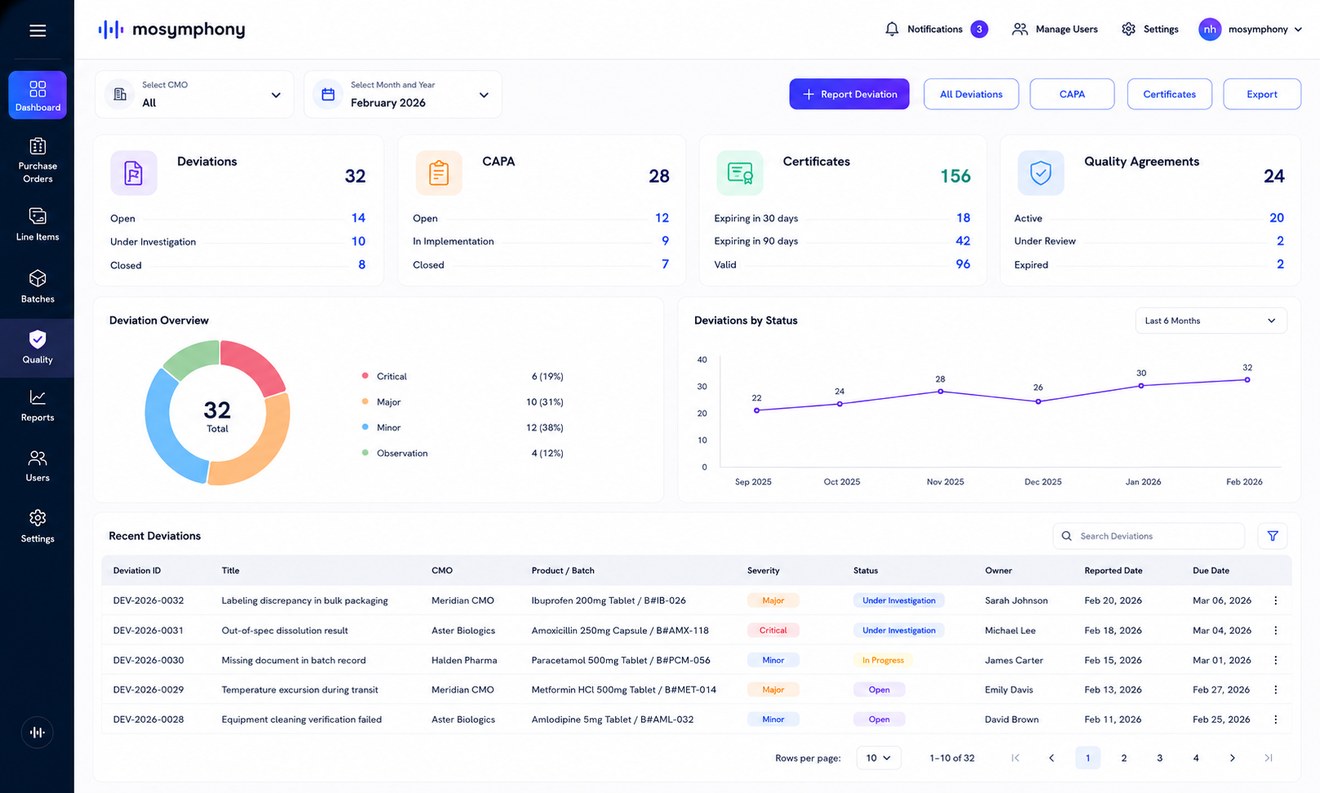
The Quality dashboard opens on the state of the network — open events by type and age, the split between what sits with each organisation, and the trend behind them — and drills into any single event, with its documents, its assessment and the queries raised against it.
Standardized ingestion
Each incoming dataset is pre-processed into a standard message format, whatever system it came from.
Standardized outbound messaging
Outbound data leaves as a standard message, on defined triggers, to the systems that consume it.
Broad system integration
Data is drawn from ERP, MES, QMS and LIMS across the sponsor and partner estate.
Role-based governance
What a user can see, and what they can act on, are both controlled by role.
Related Solutions
Quality Collaboration covers the quality record and the events raised against it. The neighbouring solutions carry the batch those events concern, the transfer that preceded it, and the shipment that follows release.
Manufacturing Collaboration
Challenge
Sponsors lack timely visibility into production at partner sites.
Outcome
Issues surface early, improving coordination and reducing delays.
Technology Transfer
Challenge
Technology transfer scattered across files — risks errors and delays.
Outcome
Faster, cleaner transfers with less rework.

Logistics Collaboration
Challenge
Shipment coordination relies on manual follow-up.
Outcome
Improved coordination and fewer delays.